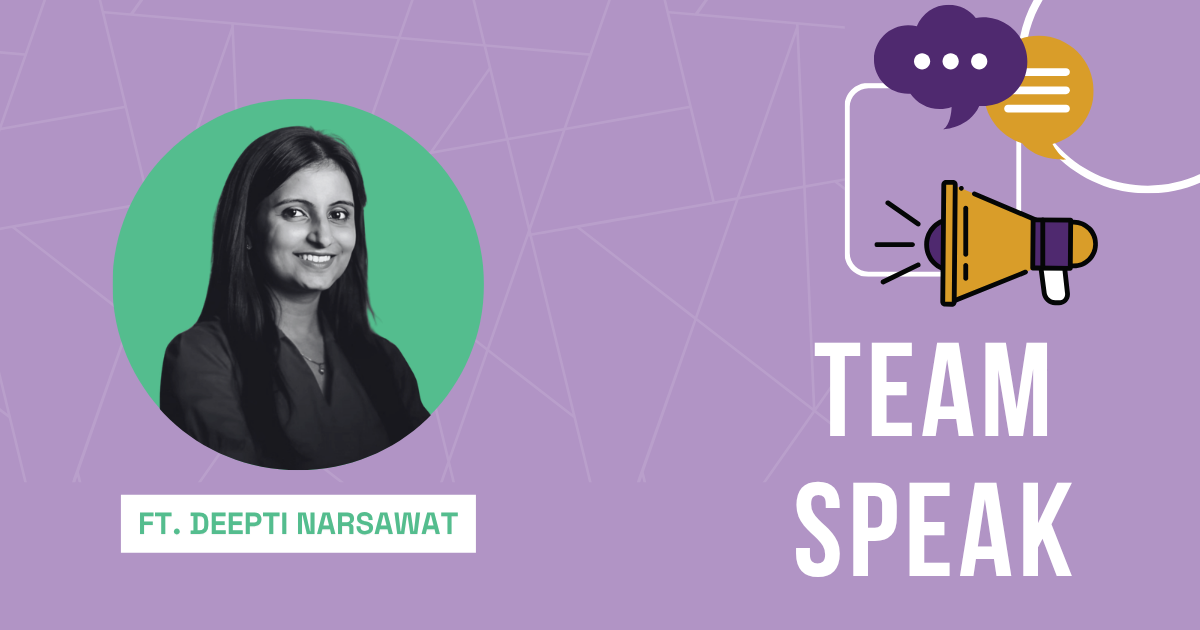
For Deepti Narsawat, some of the most valuable lessons in evaluation haven’t come from data alone, but from the questions, conversations, and unexpected realities encountered along the way. Over the years, these experiences have shaped not only how she approaches evidence, but also why she remains deeply connected to the work.
In this edition of Team Speak, she reflects on the perspectives and moments that continue to influence how she listens, learns, and engages with the field.
Deepti (D): Each of the programme that I have evaluated has been unique in terms of what the evaluation sought to understand. We always move ahead with a consensus with the client on the key indicators to be captured as part of the research study. However, what I often find missing in the data is the qualitative depth and contextual information that defines why outcomes vary across geographies.
Over time, I've realised that numbers alone don't always tell us how a programme is actually experienced on the ground. The role of different actors and institutions, the local context, and the realities of implementation often shape impact in ways that quantitative data cannot fully capture. Anecdotal evidence, conversations with implementation staff, and a structured synthesis of these perspectives help bring those missing pieces together and provide a much richer understanding of how programmes work in practice.
D: Indeed, in any setup you work it is always complex, I always approach stakeholder engagements through triangulation, bringing together multiple streams of evidence so that the findings don't rest on a single data point or perspective. That rigour gives me confidence in the insights I share.
At the same time, I've learned that how findings are communicated is just as important as the findings themselves. I try to present evidence not as a critique of what went wrong, but as an explanation of trends and the pathways behind them. When a funder or a government official can see why something is happening, not just that it happened, the conversation shifts from defensive to constructive.
One principle I keep coming back to is framing findings as learnings rather than judgment. I’ve found that it creates space for honest conversations and better decision-making.
D: Over the years, I've had many interactions that have stayed with me in different ways. Some have been deeply surprising, moments when the realities of rural communities or women’s experiences completely challenged assumptions I had carried into the field. Others have confirmed things I expected to see, and yet those revelations have been a reminder of how persistent certain barriers continue to be.
What keeps me connected to this work is the curiosity to see how public policies and interventions change the lives and address the actual barriers on ground. For me, that's what makes this work meaningful. Understanding those nuances and systematically building evidence around them can help programmes and policies perform better. After all, data is not just information—it's a tool that can help improve decisions and create better outcomes for people.
.png)