
A week before the infamous pandemic in the year 2020, I was somewhere in the villages tucked away in the remote jungles of Jharkhand, camera in tow, notes on my phone, interviewing tribal women who were just beginning to embrace technology that could help them increase their incomes from their chosen livelihood – agriculture, jelly-making, livestock, or small businesses.
And then the world stopped.
So did my field visits. Therefore, bringing a pause to one of my most favourite things to do – tell stories from the ground.
As a Communications professional, the best of the content we put out there into the universe comes from stories that people tell.
As a Communications professional working in social impact, that statement holds even truer.
So even as I navigated jobs, helped build the brand of the organisations I worked with since then, and still told stories in some form, the one thing I had been missing over the past six years was this human connect in the field.
And then, towards the end of January 2026, life came a full circle.
I found myself travelling to Vijayawada, Andhra Pradesh, to meet farmers who were now adapting to a world increasingly being shaped by Artificial Intelligence (AI). It was an exposure visit to a project I have been working very closely with; a state government led initiative to empower farmer service centres with AI and digitalisation so they can deliver high quality services to their communities.
The goal?
To help people engaged in agriculture, fisheries, horticulture, and livestock farming increase their incomes, and ultimately strengthen the state’s agricultural economy.
As someone who is always excited about new technologies, I was interested to witness not just the way people are reacting to AI-driven technology, but also in trying to understand if the fit it natural, or forced, in their lived realities.
Like I mentioned, technology thrills me. But I am also aware that technology, without access, creates a divide. A gap that is sometimes hard to bridge. A possibility of creating a distance between the haves and have nots that just grows larger if access and empowerment are not considered from the very conception stage of the idea. And as everyone who has ever worked with agriculture or related fields would know, that this particular sector has nuances and variables that change from one place to another, from one village to the neighbouring one, and even from one family to the next.
Farming, raising livestock, or engaging in fisheries is personal. Deeply so.
But here’s what I saw.
In Andhra Pradesh, farmers are not just willing to embrace new technologies, but are informed, aware, and willing to ask questions.
And it’s the last part that left a lasting impression on me.
Over the course of the four days that I was there, I met farmers who have been growing bananas, roses, and other fruits, but also farmers who have mapped industry demand and moved on to crops like oil palm, cocoa, chrysanthemum, and jasmine. Farmers who are already using advanced technology like employing drones for precision-spraying of pesticides or rice seeding, and farmers who are inquisitive about how AI can be used to detect diseases in crops before it becomes a problem out of their control. Farmers who are not afraid to reach out to the service centres for questions, doubts, and clarifications.
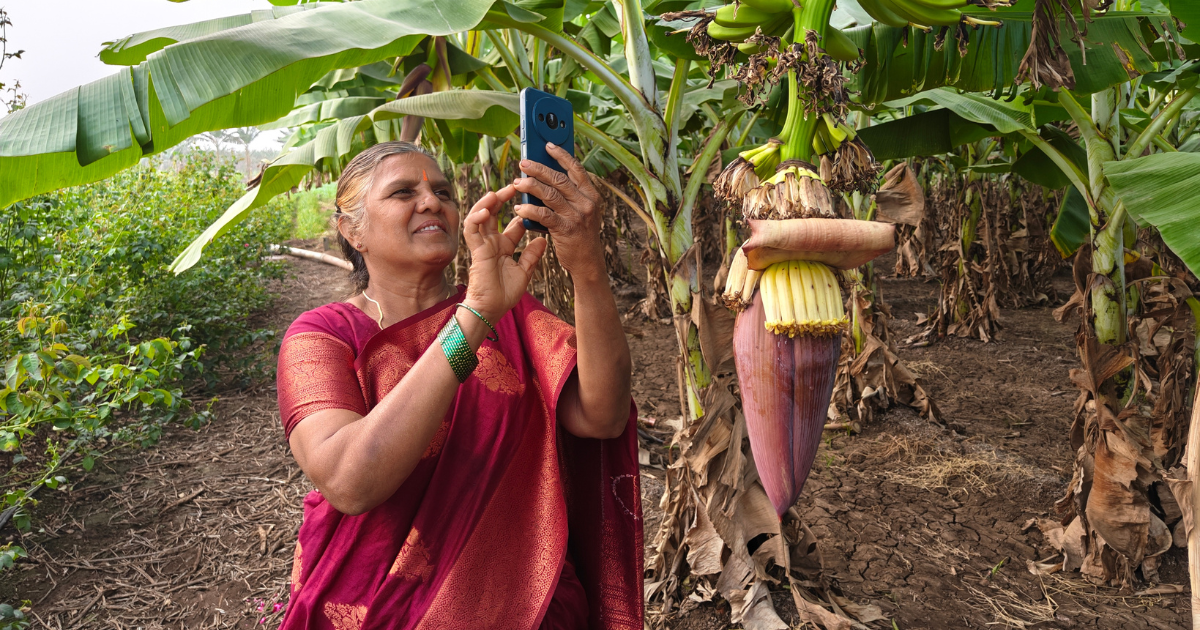
I met a lady, who has been farming for over twenty years and said, “technology is exciting," when I asked her what makes her so enthusiastic about adopting AI-driven tech. “Agriculture is advancing with time, and so should we.”
I also met a gentleman, who is helping his father and elder brother increase their profits from agriculture, who pointed out, very clearly, that “technology is helpful, only if it is farmer-friendly.”
And that’s where the State’s vision comes in and makes all the difference. To create impact at scale, the government is ready to meet the end-user mid-way through the journey, or even a step further.
How are they planning to do this?
By putting the farmer service centres, the first points of contact for the farmers, in the thick of things, right in the middle. The aim is to empower the centres with not just information and twenty new apps, but to help them tackle all the data they collect efficiently, accurately and smartly. So that the data from the ground, starts matching the data in the records. So that the data becomes usable, enables decision-making, and gives the farmer actionable insights that help them to farm better, reaping more profits at lesser costs.
Some impact of this vision is already visible. “Has anything changed in the way farmers have adopted AI-driven technology?" I asked an executive at the farmer service centre. It took her only a couple of seconds to organize her thoughts when she replied, “the drone technology was there earlier, but now it is actually being used.”
And that’s where the story of change always lies – in the intent and execution of making development, be it in technology, or any other field, accessible and adaptive to the need of the end user.
I am looking forward to more visits as the project progresses and being able to bring personalised accounts from the people who are actually going to be impacted by this project. To hear, to see, to observe how things change, to listen to stories and bring them to you, and I hope you will walk the journey with me!
About the Author

Atreyee Kar leads Branding and Communications at Athena Infonomics. With experience across sectors including financial services, consulting, public health, and social impact, she focuses on shaping narratives, building digital presence, and documenting impact.
Outside work, she enjoys blogging, photography, and exploring food, and is passionate about using communication to drive positive social change.
.png)