Agriculture
Responsible AI
Technical Assistance to Andhra Pradesh: AI Advisory in Agriculture
Government of Andhra Pradesh, Gates Foundation

Project Overview

Athena Infonomics, in partnership with Catalyst Management Services (CMS) and Vassar Labs, is supporting the Government of Andhra Pradesh (GoAP) and the Gates Foundation to design and operationalize a technology-enabled Programme Management Unit (PMU) to strengthen agrifood systems.

Aligned with the state’s Swarna Andhra@2047 vision, which targets 15% annual growth in the primary sector, the initiative focuses on enabling data-driven decision-making, climate resilience, and market-oriented pathways. The program is anchored in two key systems: APAIMS 2.0, the state’s integrated agriculture data and decision-support platform, and Rythu Seva Kendras (RSKs), transforming RSKs into dynamic, tech-enabled service and planning hubs for smallholder and tenant farmers.

Athena’s Role

Athena is leading the design and implementation of the PMU as a strategy-to-execution engine, embedded within the Department of Agriculture and working in close coordination with RSKs, farmer collectives, and line departments.

Key areas of support include:

  • PMU Design and Operationalization: Establishing an integrated PMU structure spanning strategic leadership, execution, monitoring, and learning functions.
  • RSK Strengthening and Capacity Building: Positioning RSKs as decentralized planning and service delivery nodes, equipped with decision-support tools integrating household-level GVA data, crop cycles, input needs, and grievance tracking.
  • AI-enabled Advisory Systems: Supporting the deployment of human-in-the-loop AI systems, where RSKs translate data-driven insights into actionable, context-specific advisories for farmers.
  • Digital and Data Systems Integration: Leveraging APAIMS 2.0 and interoperable data architecture (open APIs) to enable real-time, hyperlocal decision support.
  • Convergence and Coordination: Facilitating alignment across government schemes, market actors, and financial services to deliver bundled, farmer-centric solutions.
  • Monitoring, Evaluation, and Learning (MEL): Establishing systems for real-time tracking of outcomes, feedback loops, and adaptive planning to inform policy and program refinement.

Approach

The PMU adopts a bottom-up, evidence-driven model that places RSKs and farmer institutions at the center of planning and execution. Key features of the approach include:

  • Localized Planning through RSKs: Each RSK functions as a planning and monitoring unit, using household-level data to identify service gaps and align interventions with district and state targets.
  • Human-in-the-Loop AI: Combining advanced analytics with frontline extension support to ensure advisories are trusted, relevant, and actionable.
  • Integrated Service Delivery: Converging inputs, advisories, market linkages, and financial services at a single farmer-facing touchpoint.
  • Iterative Learning and Adaptation: Continuous feedback from field implementation informs system improvements, program design, and policy decisions.

Intended Outcomes

The initiative is designed to:

  • Strengthen last-mile service delivery for smallholder farmers through RSKs;
  • Enable data-driven, hyperlocal decision-making across the agriculture value chain;
  • Improve farmer access to inputs, advisories, markets, and credit;
  • Support evidence-based planning and policy formulation within the state;
  • Build a scalable and resilient model for farmer income enhancement and agrifood system transformation.

Innovation Sandbox: Bridging Innovation and Last-Mile Delivery

The Innovation Sandbox on AI and Frontier Technology is a dedicated worktream, designed to enable real-world testing of innovative digital agriculture service delivery models, particularly where underlying technologies are mature but pathways for last-mile adoption remain unproven. Acting as a commissioning and technical support partner, Athena facilitates the deployment of targeted pilots that generate practical evidence on what works in farmer-facing contexts. The Sandbox operates through catalytic risk capital, underwriting specific commercial and operational risks that private sector actors are unable to absorb during early-stage validation, thereby enabling experimentation, learning, and the identification of scalable, field-ready solutions.

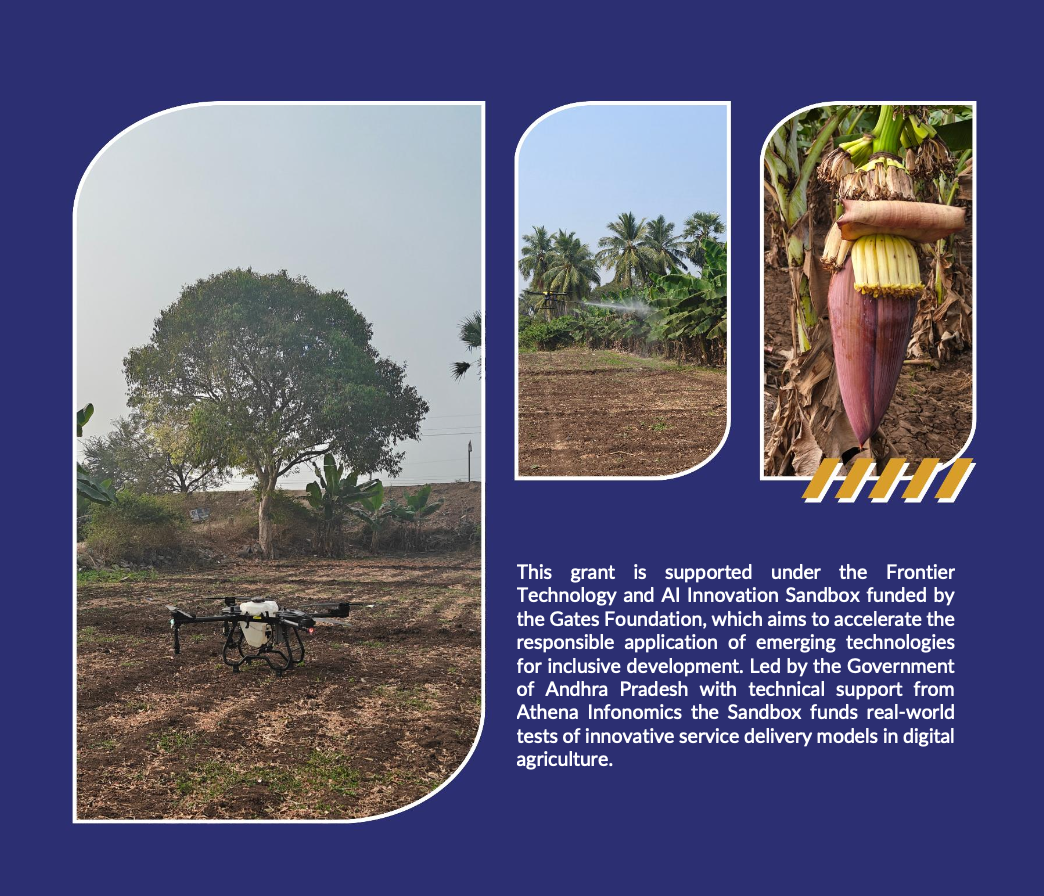
As part of the Innovation Sandbox, Athena Infonomics has launched a competitive viability grant to test scalable, drone-based agricultural service models in Andhra Pradesh. The grant supports real-world validation of commercially viable, farmer-centric delivery systems with potential for statewide scale.
Download the document!

Additional Reads: 

  1. A New Chapter in Farmer-Centric System Strengthening in Andhra Pradesh
  2. What a Young Farming Couple Taught Me About Assumptions
  3. One Woman’s Support, Many Women’s Confidence

For any project related queries, reach out to Soumya Alamuru and Ankit Chatri.